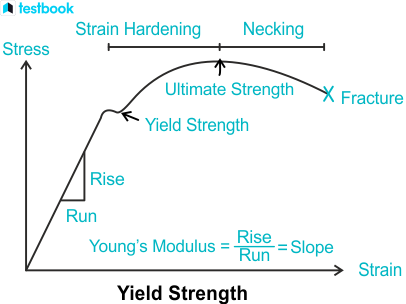
Practical Applications of Yield Stress Formula in Design
Ever wondered how engineers ensure bridges don't collapse or that your car's suspension can handle bumpy roads? The answer lies, in part, with understanding yield stress. It's a critical material property that determines when a solid material begins to deform permanently. Ignoring yield stress in design can lead to catastrophic failures, making it a crucial concept for anyone involved in mechanical engineering, structural design, or materials science.
Understanding Yield Stress
Yield stress is the amount of stress a solid material can withstand before it begins to deform permanently. Below this stress, the material will return to its original shape once the stress is removed (elastic deformation). Above it, the material undergoes permanent deformation (plastic deformation). This transition point is vital for designing safe and reliable structures and components.
Defining Yield Stress
In simpler terms, think of a rubber band. When you stretch it slightly, it snaps back to its original length. This is elastic deformation. But if you stretch it too far, it becomes permanently elongated. That point where it starts to stretch permanently is related to its yield strength.
Yield Strength vs. Tensile Strength
It's important to differentiate between yield strength and tensile strength. Yield strength marks the onset of plastic deformation, while tensile strength is the maximum stress a material can withstand before it starts to fracture. A material can yield without breaking, but it cannot exceed its tensile strength without fracturing. Understanding both is key to robust design. Tensile and compressive stress are both forces applied to a material, but tensile stress pulls the material apart, while compressive stress squeezes it together.
The Yield Stress Formula
While "the" yield stress formula doesn't exist in the same way as, say, the formula for stress (σ = F/A), understanding how yield stress (often denoted as σy or Sy) isusedin calculations is crucial. We typically use experimentally determined values of yield stress within other design equations. For example, a common application uses the yield stress in conjunction with a safety factor (SF) to determine the allowable stress (σallowable):
σallowable = σy / SF
This allowable stress is then used in design calculations to ensure the applied stress remains below the yield point, even with the safety factor applied.
Practical Applications in Engineering Design
The yield stress formula finds uses across numerous mechanical engineering and structural design applications. It is a cornerstone in failure analysis and choosing the proper materials.
Structural Engineering
In bridge and building design, engineers meticulously calculate the stresses that different structural elements will experience. They use yield stress data to select materials that can withstand these loads without permanent deformation. This ensures the long-term stability and safety of the structure.
Automotive Engineering
Car components, such as suspension springs and chassis parts, are subjected to significant stress during operation. Engineers use yield stress data to design these components so they can withstand these forces and provide a safe and comfortable driving experience. The choice of material impacts performance and lifespan of the vehicle.
Aerospace Engineering
Aircraft components need to be both strong and lightweight. Aerospace engineers carefully select materials with high yield strength-to-weight ratios to ensure structural integrity while minimizing weight, maximizing fuel efficiency and payload capacity.
Manufacturing Processes
Yield stress also plays a role in manufacturing processes like forging, rolling, and extrusion. Understanding the yield stress of the material being processed allows engineers to control the forming process accurately and achieve the desired shapes and dimensions. If the stress exceeds the yield point in an uncontrolled way, the manufactured parts may be unusable.
Case Study: Designing a Steel Beam
Let's imagine designing a steel beam to support a load in a building. Here's a simplified approach:
- Determine the Load: Calculate the maximum load the beam will need to support.
- Select a Steel Grade: Choose a steel grade (e.g., A36 steel) and find its yield strength (e.g., 250 MPa).
- Apply a Safety Factor: Choose a suitable safety factor (e.g., 1.5). This accounts for uncertainties in load calculations and material properties.
- Calculate Allowable Stress: Divide the yield strength by the safety factor: σallowable = 250 MPa / 1.5 =
166.67 MPa.
- Beam Size Selection: Use structural engineering principles (bending moment diagrams, section modulus calculations) to select a beam size that ensures the maximum stress in the beam under the calculated load does not exceed the allowable stress (166.67 MPa).
This simplified example demonstrates how yield stress, combined with a safety factor, is used to determine the allowable stress for a structural component.
Pros and Cons of Considering Yield Stress
Like any engineering consideration, understanding yield stress has advantages and disadvantages.
Pros
- Safety: Prevents catastrophic failures by ensuring components don't undergo permanent deformation under expected loads.
- Reliability: Improves the lifespan and reliability of products by preventing premature wear and tear.
- Optimization: Allows for efficient material selection and design, minimizing material usage and cost.
Cons
- Complexity: Accurate yield stress determination requires material testing and analysis, which can be time-consuming and expensive.
- Variability: Yield stress can vary depending on factors like temperature, material processing, and loading rate. These need to be accounted for in the design.
- Oversimplification: Relying solely on yield stress might not capture the complete picture of material behavior, especially for complex loading scenarios or advanced materials. Other factors like fatigue strength and creep resistance may be more important in certain cases.
Common Mistakes to Avoid
When applying the yield stress formula (or rather, utilizing yield stress data in your design), watch out for these common pitfalls:
- Ignoring Safety Factors: Failing to incorporate adequate safety factors can lead to designs that are too close to the yield point, increasing the risk of failure.
- Using Inaccurate Data: Using outdated or unreliable yield stress data can lead to incorrect calculations and flawed designs. Always refer to reputable material property databases and consider the specific grade and condition of the material.
- Neglecting Environmental Effects: Failing to account for the effects of temperature, corrosion, or other environmental factors on yield stress can compromise the integrity of the design.
- Oversimplifying Loading Conditions: Assuming simple loading conditions when the actual loading is more complex can lead to underestimation of stresses and potential failure.
Frequently Asked Questions
Here are some frequently asked questions related to yield stress and its applications:
What happens if a material is stressed beyond its yield point?
If a material is stressed beyond its yield point, it will undergo permanent deformation. This means that when the stress is removed, the material will not return to its original shape. Repeated stressing beyond the yield point can also lead to fatigue failure.
How is yield stress determined experimentally?
Yield stress is typically determined through tensile testing. A specimen of the material is subjected to a controlled tensile force, and the stress-strain curve is plotted. The yield stress is identified as the point on the curve where the material begins to exhibit significant plastic deformation (often using the 0.2% offset method).
Does yield stress change with temperature?
Yes, yield stress is generally temperature-dependent. For most metals, yield stress decreases as temperature increases. This is an important consideration in applications where components are exposed to elevated temperatures.
Is yield stress the same for all materials?
No, yield stress varies significantly between different materials. For example, steel typically has a much higher yield stress than aluminum. Even within the same material family, different alloys or grades can have different yield strengths. That is why material selection is important to the overall structural design.
How does yield stress relate to fatigue strength?
While yield stress indicates the point of permanent deformation under a single load, fatigue strength represents a material's ability to withstand repeated loading cycles. Materials stressed repeatedly below their yield strength can still fail due to fatigue. Therefore, both yield strength and fatigue strength are important considerations in design, depending on the application.
What is the difference between upper and lower yield strength?
Some materials, particularly certain steels, exhibit a distinct "yield point phenomenon," where the stress initially drops slightly after reaching the yield point before continuing to increase with strain. The initial peak stress is termed the "upper yield strength," while the lower stress level after the drop is called the "lower yield strength." In design, the lower yield strength is typically used to provide a more conservative estimate of the material's yield behavior.
Conclusion
Understanding yield stress and its practical applications is fundamental to sound engineering design. By considering yield stress, engineers can create safer, more reliable, and more efficient structures and components. Don't underestimate the power of this seemingly simple concept – it's a cornerstone of structural integrity. So keep exploring, keep learning, and keep designing with confidence!
Posting Komentar untuk "Practical Applications of Yield Stress Formula in Design"