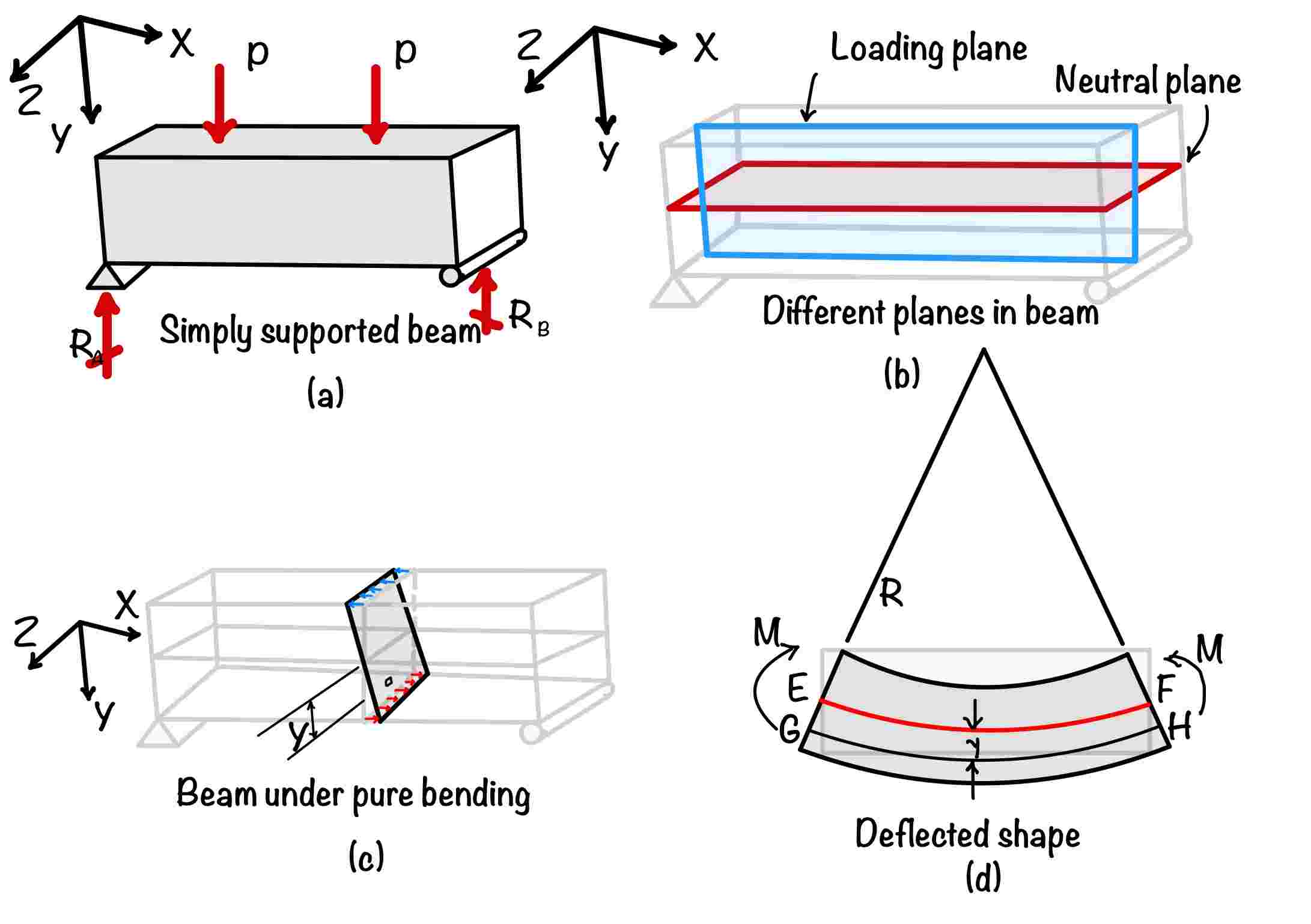
Derivation of Engineering Stress Formula in Strength of Materials
Ever wonder what keeps bridges standing or airplanes soaring? The answer lies, in part, with understanding stress within materials. Stress, a fundamental concept in mechanical engineering, dictates how a material responds to external forces. More specifically, engineering stress is our entry point to understanding material behavior in the face of applied loads. It's a critical calculation that forms the basis for safe and efficient structural design, and the first step toward preventing catastrophic failures.
Understanding Stress: A Foundation
Before diving into the derivation of the engineering stress formula, it's vital to grasp what stress actually represents. Stress is a measure of the internal forces acting within a deformable body. These internal forces arise as a reaction to external loads applied to the object. Think of it as the material's resistance to being deformed.
Imagine pulling on a rubber band. You're applying an external force. The rubber band resists this force, creating internal stresses. These stresses are distributed throughout the cross-sectional area of the rubber band. Understanding and quantifying this stress is crucial for predicting how the material will behave under load.
Defining Engineering Stress
Engineering stress, also known as nominal stress, provides a simplified yet practical way to quantify this internal resistance. It's defined as the applied force divided by the original cross-sectional area of the material. This is a key distinction from true stress, which uses the instantaneous area.
Why use theoriginalarea? Because it's much easier to measure! In many engineering applications, especially during initial design phases, the change in area is relatively small, making engineering stress a reasonable and convenient approximation.
Deriving the Engineering Stress Formula
The derivation of the engineering stress formula is straightforward, relying on basic principles of mechanics and material properties.
Let's define our terms:
σ = Engineering stress (typically measured in Pascals (Pa) or pounds per square inch (psi))
F = Applied force (typically measured in Newtons (N) or pounds (lb))
A0 = Original cross-sectional area of the material (typically measured in square meters (m2) or square inches (in2))
The engineering stress formula is then simply expressed as:
σ = F / A0
Step-by-Step Explanation
Identify the Applied Force (F): Determine the magnitude of the force acting on the material. This force could be tensile (pulling), compressive (pushing), or shear (tangential).
Determine the Original Cross-Sectional Area (A0): Measure the cross-sectional area of the materialbeforeany load is applied. This is crucial for calculating engineering stress.
Calculate Engineering Stress (σ): Divide the applied force (F) by the original cross-sectional area (A0). The resulting value is the engineering stress experienced by the material.
Practical Applications and Examples
The engineering stress formula isn't just a theoretical concept. It's used daily in various engineering applications, including structural design, failure analysis, and material selection.
Example 1: A steel rod with an original cross-sectional area of 0.001 m2 is subjected to a tensile force of 10,000 N. The engineering stress is calculated as: σ = 10,000 N /
0.001 m2 = 10,000,000 Pa = 10 MPa.
Example 2: A concrete column with an original cross-sectional area of 0.25 m2 is subjected to a compressive force of 500,000 N. The engineering stress is calculated as: σ = 500,000 N /
0.25 m2 = 2,000,000 Pa = 2 MPa.
These simple calculations allow engineers to compare the calculated stress to the material's yield strength and ultimate tensile strength, ensuring that the structure can withstand the applied loads without failure.
Advantages and Limitations of Engineering Stress
Like any simplified model, engineering stress has both advantages and limitations. Understanding these is crucial for proper application of the concept.
Advantages:
Simplicity: The formula is easy to understand and apply, requiring only basic measurements.
Ease of Calculation: Calculation is straightforward and doesn't require complex numerical methods.
Practicality: Provides a reasonable approximation for many engineering applications, especially when deformations are small.
Limitations:
Neglects Area Change: Ignores the change in cross-sectional area during deformation, leading to inaccuracies at high strain levels.
Underestimates True Stress: Underestimates the actual stress experienced by the material, especially near the point of necking (localized reduction in cross-sectional area).
Not Suitable for Large Deformations: Not accurate for materials undergoing significant plastic deformation.
For situations involving large deformations or highly localized stresses, the concept of true stress and true strain becomes more appropriate.
Engineering Stress vs. True Stress
While engineering stress uses the original area, true stress uses the instantaneous or actual cross-sectional area at any given point during loading. As a material deforms, its cross-sectional area changes, especially under tension. True stress provides a more accurate representation of the stress experienced by the material, particularly at higher strains. This is essential for tasks like failure analysis, where understanding the behavior of a material close to its breaking point is crucial.
The formula for true stress (σt) is: σt = F / A, where A is the instantaneous area.
Conclusion
The engineering stress formula is a fundamental tool in the field of strength of materials and structural design. It provides a straightforward method for quantifying the internal stresses within a material subjected to external loads. While it has limitations, especially when dealing with large deformations, its simplicity and practicality make it an invaluable tool for initial design considerations and many engineering applications. Keep practicing with examples and real-world scenarios to solidify your understanding. Remember, a solid grasp of engineering stress is a key stepping stone towards becoming a skilled and confident engineer.
Frequently Asked Questions
What are the units of engineering stress?
Engineering stress is typically measured in Pascals (Pa) or pounds per square inch (psi). Other units like megapascals (MPa) and kilopounds per square inch (ksi) are also commonly used, especially for materials with high strength.
When is it appropriate to use engineering stress instead of true stress?
Engineering stress is appropriate when the deformations are small and the change in cross-sectional area is negligible. It's generally suitable for initial design calculations and when the material is within its elastic region. True stress is more appropriate when deformations are large or when analyzing material behavior near failure.
How does temperature affect engineering stress calculations?
Temperature can significantly affect the material's properties, such as yield strength and modulus of elasticity. These changes in material properties will influence the relationship between stress and strain. In high-temperature environments, creep (time-dependent deformation under constant stress) can also become a significant factor.
What is the difference between stress and pressure?
While both stress and pressure have units of force per unit area, they represent different concepts. Pressure is an external force applied uniformly over an area, whereas stress is an internal force within a material resisting deformation due to external loads. Stress can be tensile, compressive, or shear, while pressure is typically compressive.
Can engineering stress be negative?
Yes, engineering stress can be negative. A negative value indicates compressive stress, meaning the material is being squeezed or compressed. Positive stress indicates tensile stress, meaning the material is being pulled or stretched.
How does engineering stress relate to safety factors in design?
Engineering stress is used to determine the actual stress experienced by a structural component. This calculated stress is then compared to the material's allowable stress (which is typically the yield strength or ultimate tensile strength divided by a safety factor). The safety factor ensures that the structure can withstand loads beyond its expected operating conditions, providing a margin of safety against failure.
Posting Komentar untuk "Derivation of Engineering Stress Formula in Strength of Materials"