How to Apply Principal Stress Formula in Mohr’s Circle
Ever wondered how engineers predict when a bridge might fail under heavy traffic, or how a plane’s wing withstands incredible forces during flight? It all comes down to understanding stress – specifically, principal stresses. The ability to determine these stresses, and visualize them with Mohr's Circle, is a cornerstone of mechanical engineering, crucial for ensuring the safety and reliability of countless structures and designs. This guide will demystify the process, providing you with the knowledge to confidently apply the principal stress formula within the context of Mohr’s Circle.
Understanding Principal Stress and Mohr's Circle
Principal stresses represent the maximum and minimum normal stresses at a specific point in a material. Imagine a tiny square within a stressed object; principal stresses act perpendicularly to the sides of that square where shear stress is zero. These stresses are critical because they directly relate to the potential for material failure. Mohr's Circle, on the other hand, is a graphical representation of the stress state at a point, allowing us to visualize the relationship between normal and shear stresses on different planes.
Together, the principal stress formula and Mohr's Circle provide a powerful toolkit for analyzing stress states. Let's dive into how they work together.
The Principal Stress Formula: A Deep Dive
The principal stresses, often denoted as σ1 (maximum principal stress) and σ2 (minimum principal stress), can be calculated using the following formulas:
σ1 = (σx + σy)/2 + √[((σx - σy)/2)² + τxy²]
σ2 = (σx + σy)/2 - √[((σx - σy)/2)² + τxy²]
Where:
- σx is the normal stress in the x-direction.
- σy is the normal stress in the y-direction.
- τxy is the shear stress.
These formulas are derived from considering the equilibrium of forces on a stressed element and solving for the angles where shear stress is zero (i.e., where normal stress is maximized or minimized). Mastery of these formulas is a must for structural design and failure analysis.
Derivation of the Principal Stress Formula
The derivation involves coordinate transformation of stress components to a plane where the shear stress vanishes. This involves finding the angle θ where the shear stress becomes zero. Solving for this angle and substituting back into the stress transformation equations yields the principal stress formulas. Understanding the derivation provides a much deeper understanding than simply memorizing the formula.
Constructing Mohr's Circle
Mohr's Circle provides a visual representation of the stress state. Here's how to construct it:
- Draw a set of coordinate axes, with normal stress (σ) on the horizontal axis and shear stress (τ) on the vertical axis.
- Plot the stress point (σx, τxy) and (σy, -τxy). Note the change in sign for the shear stress when plotting the second point.
- Connect these two points with a line. The midpoint of this line represents the center of Mohr's Circle. The coordinates of the center are ((σx + σy)/2, 0).
- Draw a circle with the center found in step 3 and a radius equal to the distance from the center to either of the plotted stress points. This radius is also equal to √[((σx - σy)/2)² + τxy²].
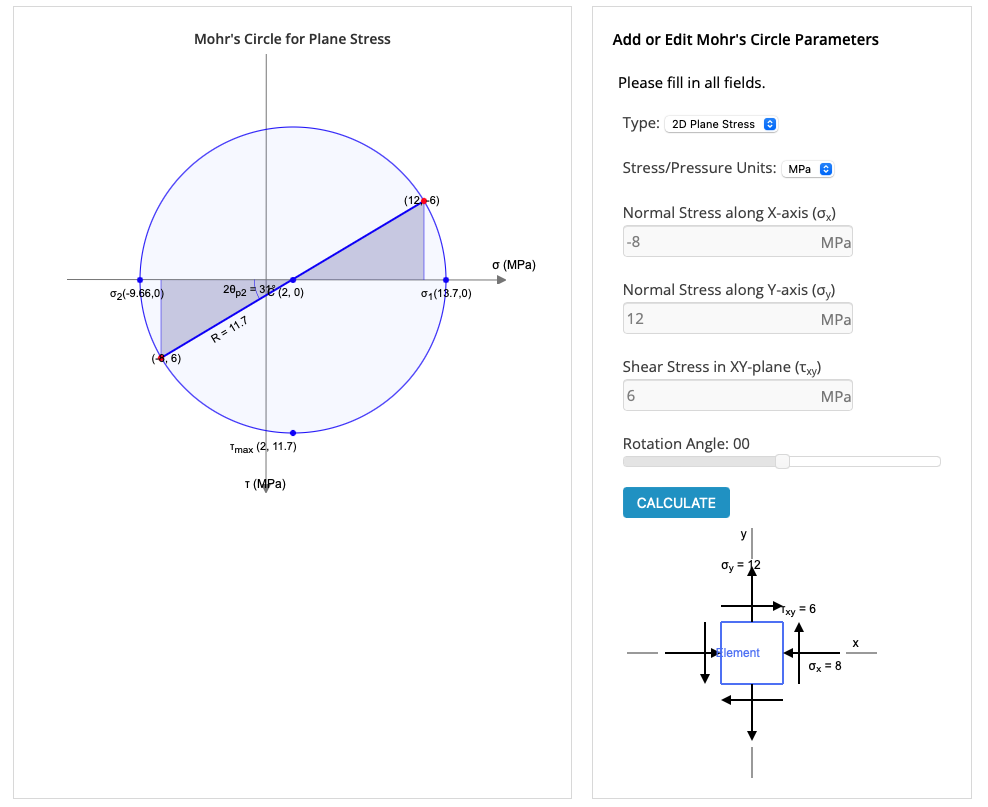
The points where the circle intersects the horizontal axis represent the principal stresses, σ1 and σ2. The highest and lowest points on the circle represent the maximum shear stress and its corresponding normal stress.
Applying the Principal Stress Formula within Mohr's Circle
Mohr's Circle provides a visual verification of the principal stress formula. The x-coordinates where the circle intersects the horizontal axis correspond directly to the values calculated using the principal stress formula. The center of the circle, ((σx + σy)/2, 0), represents the average normal stress, while the radius represents the maximum shear stress.
By measuring the coordinates of these points on your meticulously drawn circle, you can confirm your calculated values. This visual confirmation is extremely helpful for students and professionals alike, reinforcing your understanding of stress transformation.
Example: Calculating Principal Stresses and Using Mohr's Circle
Let's say a material is subjected to the following stresses: σx = 100 MPa, σy = 50 MPa, and τxy = 25 MPa. Calculate the principal stresses and construct Mohr's Circle.
- Calculate Principal Stresses:
- σ1 = (100 + 50)/2 + √[((100 - 50)/2)² + 25²] = 75 + √(625 + 625) = 75 + √1250 ≈ 75 + 35.36 ≈
110.36 MPa
- σ2 = (100 + 50)/2 - √[((100 - 50)/2)² + 25²] = 75 - √(625 + 625) = 75 - √1250 ≈ 75 - 35.36 ≈
39.64 MPa
- Construct Mohr's Circle:
- Center: ((100 + 50)/2, 0) = (75, 0)
- Radius: √[((100 - 50)/2)² + 25²] = √1250 ≈ 35.36
When you draw Mohr's Circle, the points where the circle intersects the horizontal axis should closely correspond to σ1 ≈ 110.36 MPa and σ2 ≈
39.64 MPa, visually validating your calculations.
Practical Applications of Principal Stress and Mohr's Circle
The concepts of principal stress and Mohr's Circle are fundamental in various fields:
- Structural Engineering: Designing bridges, buildings, and other structures to withstand loads safely.
- Mechanical Engineering: Analyzing stress in machine components, ensuring their reliability and preventing failure.
- Aerospace Engineering: Designing aircraft and spacecraft to withstand extreme stresses during flight.
- Geotechnical Engineering: Analyzing soil and rock stresses for foundation design and slope stability.
Understanding these concepts allows engineers to make informed decisions about material selection, component geometry, and load-bearing capacity, ultimately ensuring the safety and longevity of engineered systems.
Pros and Cons of Using Mohr's Circle
Pros:
- Visual representation simplifies complex stress states.
- Provides a clear understanding of stress transformation.
- Facilitates easy determination of principal stresses and maximum shear stress.
Cons:
- Can be time-consuming to construct accurately.
- Less precise than direct calculation methods for complex scenarios.
- Primarily applicable for two-dimensional stress states. Three-dimensional stress states require more advanced techniques.
FAQs
What is the significance of the angle in Mohr's Circle?
The angle in Mohr's Circle represents twice the physical angle on the actual stressed element. This is because Mohr's Circle depicts the transformation of stress as the element is rotated.
Can Mohr's Circle be used for three-dimensional stress states?
While the basic Mohr's Circle is primarily for 2D stress states, there are extensions to handle 3D stress. In 3D, you would have three Mohr's Circles representing the stress states in different planes.
How does the material's yield strength relate to principal stresses?
Yield strength is a critical material property. If either of the principal stresses exceeds the material's yield strength, the material will undergo permanent deformation. The Von Mises yield criterion, often used in conjunction with principal stresses, provides a more comprehensive assessment of yielding under multiaxial stress states.
What are the limitations of using the principal stress formula?
The principal stress formula assumes linear elastic material behavior and small deformations. It may not be accurate for materials exhibiting non-linear behavior or subjected to large deformations. Additionally, stress concentrations (e.g., near holes or sharp corners) can significantly alter the stress distribution and render the formula less reliable.
How does shear stress affect the calculation of principal stresses?
Shear stress plays a crucial role in determining the magnitude and orientation of the principal stresses. The presence of shear stress causes the principal stresses to be oriented at an angle to the original coordinate system. The greater the shear stress, the larger the difference between the principal stresses and the original normal stresses.
What's the difference between stress and pressure in this context?
While related, they're not the same. Stress is aninternalforce per unit areawithina material, caused by external loads or forces. Pressure is anexternalforce per unit area appliedtoa surface. In many engineering problems, pressurecausesstress within a material.
Conclusion
Understanding and applying the principal stress formula in conjunction with Mohr's Circle is an essential skill for engineers and anyone involved in structural design or failure analysis. This powerful combination provides both a quantitative and visual understanding of stress states, enabling safer and more reliable designs. So, keep practicing, keep visualizing, and keep building!
Posting Komentar untuk "How to Apply Principal Stress Formula in Mohr’s Circle"